
Fine Mineral Fraction Recovery & Beneficiation
Recovering value from the size fractions conventional circuits lose.
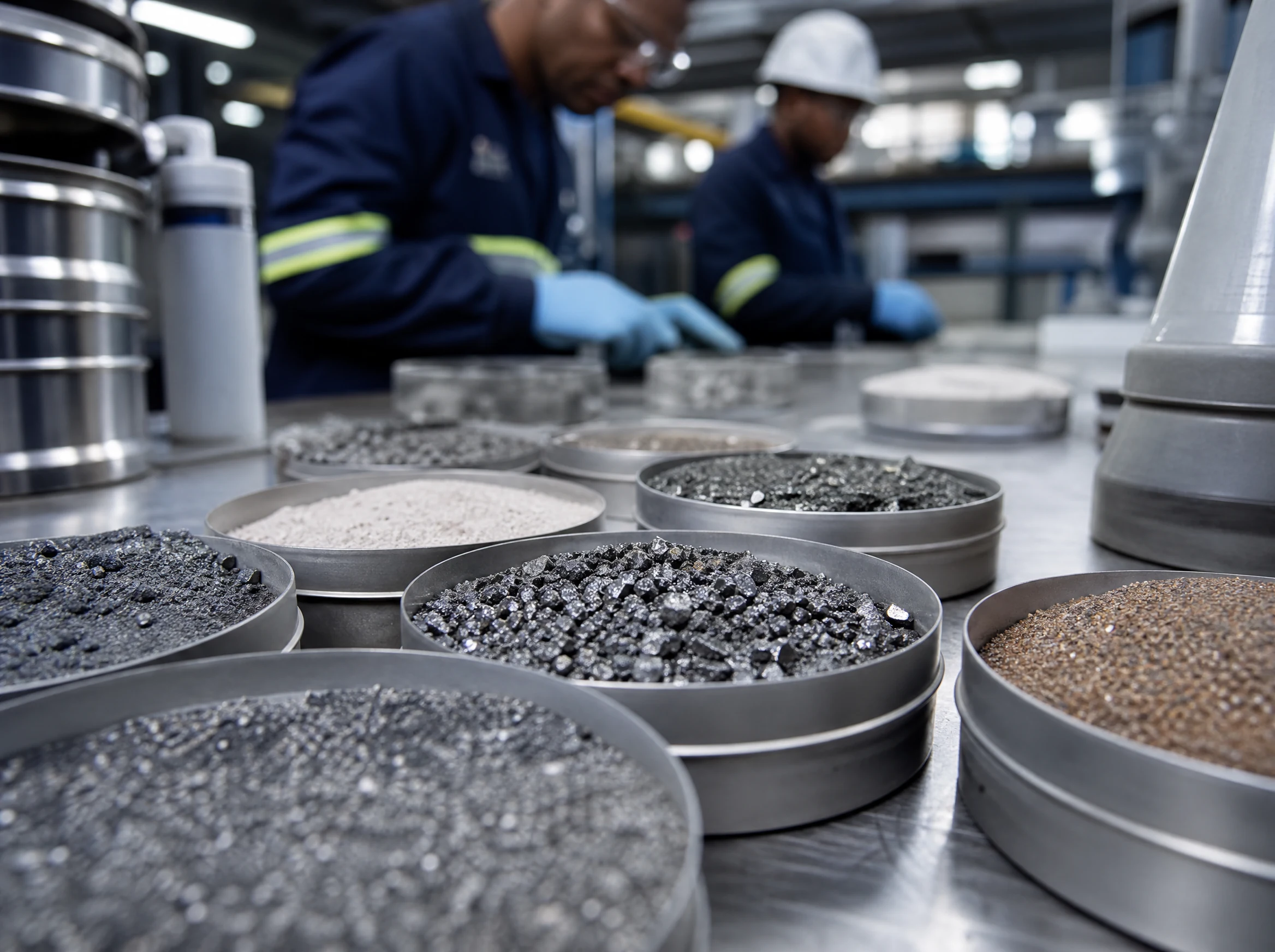
Fine fractions are where conventional circuits leak value. Conventional gravity separation loses efficiency as particle size falls, which means fines frequently report to residue carrying recoverable material with them.
Why are fine fractions difficult?
Separation technologies that rely on density become progressively less effective as particle size decreases, because the gravitational force acting on a particle falls faster than the drag resisting it. Below a certain size, conventional gravity separation simply stops discriminating.
The result is that fines often report to residue carrying recoverable value. Recovering it requires technologies that work on a different principle, or that intensify the one being used.
Intensify the field, or change the principle
Enhanced gravity separation applies a centrifugal field many times greater than gravity, extending density separation into finer sizes. Flotation works on surface chemistry rather than density and is well suited to fine material.
Magnetic separation remains effective at fine sizes where the target responds. Which applies is settled by test work on the actual fraction.
- Enhanced gravity separation for extended fine density recovery
- Flotation where surface chemistry offers better selectivity
- Magnetic separation where the target responds at fine sizes
Technologies considered
Shortlisted on material behaviour, then discriminated by bench test work.
Gravity Separation
Conventional and enhanced gravity separation where density contrast supports recovery.
Dense Medium Separation
DMS for coarse pre-concentration and early rejection of barren material.
Flotation
Surface-chemistry-based separation for finer fractions and complex mineralogy.
Magnetic Separation
Magnetic and electromagnetic separation across a range of intensities.
Pre-Reduction
Thermal pre-treatment to change phase behaviour ahead of downstream recovery.
Integrated Routes
Combined circuits where no single technology carries the full recovery duty.

Fines are usually a volume argument
Fine fractions typically carry lower grade than coarser material, so viability tends to rest on the volume available and on processing cost per tonne rather than on grade alone.
That makes the economic assessment as important as the technical one, and it is why both are developed together.
Recovery & BeneficiationHow the route is proven
No scale-up recommendation is made ahead of the test work that supports it.
Characterise
Chemistry, mineralogy, particle size and deportment of the target element.
Screen
Compare candidate technologies against how the material actually behaves.
Bench Test
Controlled bench-scale work designed to discriminate between routes.
Model
Mass and energy balances to size the circuit and expose sensitivities.
Pilot
Integrated pilot running where scale-dependent behaviour carries real risk.
Engineer
Process engineering and implementation support for a proven route.
Frequently asked
Because density-based separation loses discrimination as particle size falls — the gravitational force on a particle drops faster than the drag resisting it. Below a certain size, conventional gravity circuits stop working.
Enhanced gravity separation, flotation and magnetic separation are the usual candidates, alone or combined. Selection depends on the target's surface behaviour, magnetic response and density contrast at the relevant size.
Because fine-particle behaviour is difficult to predict from bulk composition. Surface chemistry, slimes content and viscosity effects all influence the result and have to be measured on the actual fraction.
Discuss your material or process challenge
If you hold a residue stream, by-product, tailings resource or slag with possible recoverable value — or a process that is not performing as designed — we are interested in the technical detail.